

 EN
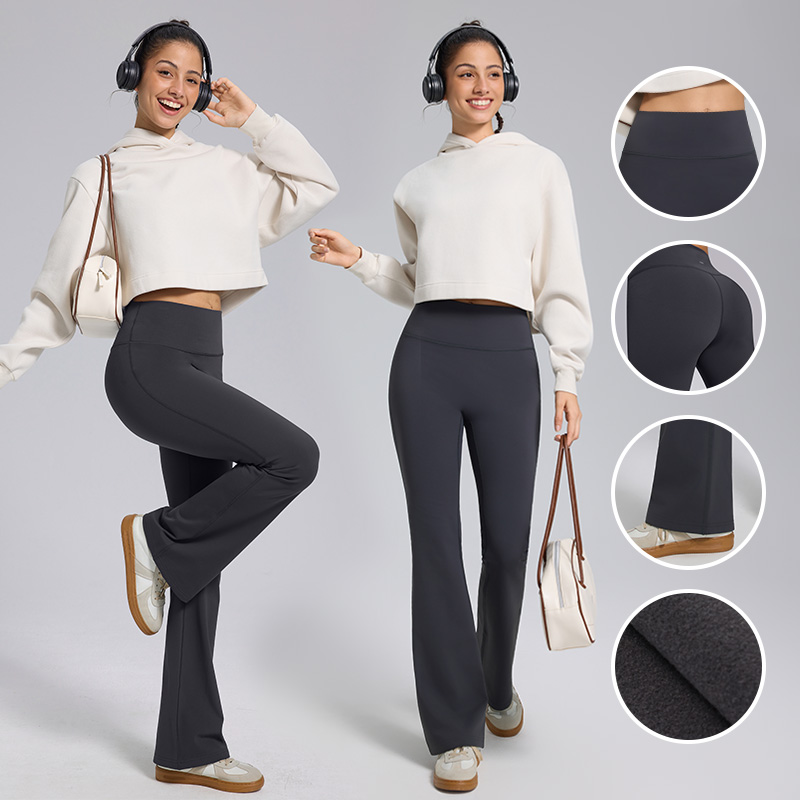
Fabric Technology: The Foundation of Performance Gym Leggings
Moisture-wicking vs. breathability: Prioritizing thermoregulation in HIIT
Moisture-wicking and breathability are distinct but complementary fabric properties. Wicking moves sweat from skin to the outer surface via capillary action; breathability enables airflow through the textile to support evaporative cooling. During HIIT, core temperature can rise by ~1°F every five minutes—making both functions essential. A 2023 study in the International Journal of Sports Physiology found athletes wearing high-wicking garments maintained a 0.7°C lower core temperature after 30 minutes of cycling versus cotton-blend wearers. In explosive movements like burpees or box jumps, saturated fabric increases friction and discomfort. While rapid moisture transfer is often the first line of defense for a drier microclimate, breathability prevents clamminess: modern performance leggings commonly use hybrid knits—polyester-faced for wicking and drying, with inner nylon-spandex layers for softness and recovery—to balance both.
Nylon-spandex vs. polyester-elastane: Real-world performance trade-offs for gym leggings
Nylon-spandex (typically 70–80% nylon, 20–30% spandex) and polyester-elastane blends dominate high-performance gym leggings—and each brings clear strengths. Nylon excels in durability and stretch recovery, resisting pilling and shape loss even after 50+ washes. Its smooth hand feel delivers a sculpting, compressive fit ideal for weight-bearing moves like squats and lunges. Polyester, by contrast, offers superior moisture management—wicking up to 40% faster than untreated nylon and drying more quickly—making it advantageous during prolonged, sweat-heavy HIIT sessions. However, polyester-based leggings may lose compression faster and are more prone to static cling. A 2024 Journal of Textile and Apparel Technology wear trial with 60 participants showed nylon-spandex leggings retained 95% of their original compression force after 30 HIIT workouts, while polyester-elastane pairs dropped to ~88%. To bridge this gap, many premium brands now use double-knit constructions: polyester on the outer face for rapid drying, nylon on the inner for comfort and recovery—optimizing for both heat management and structural integrity.
Medical-grade compression: Balancing support, circulation, and heat management
Medical-grade compression in gym leggings refers to graduated pressure measured in mmHg—typically 15–20 mmHg, aligned with Class 1 medical support standards. A 2022 Sports Medicine meta-analysis of 18 studies concluded that 15–20 mmHg lower-leg compression reduced muscle oscillation by 30% and post-exercise creatine kinase levels by 18%, indicating less muscle damage. Yet for HIIT, thermal regulation remains non-negotiable: compression reduces air space between skin and fabric, raising local skin temperature. Research in the European Journal of Applied Physiology (2023) found full-length tights delivering 23 mmHg increased core temperature by 0.4°C over 45 minutes of intense running. The optimal solution lies in targeted, graduated compression—strongest at the ankle and tapering upward—to support venous return without trapping heat. Strategically placed lightweight mesh panels or laser-cut perforations behind the knees and along the thighs further enhance ventilation. When selecting, verify the mmHg rating and confirm gradient distribution—not just total compression—to ensure circulatory benefits don’t compromise thermoregulation.
Seam Engineering: Durability and Mobility for Repetitive High-Intensity Motion
High-intensity workouts demand gym leggings engineered to endure explosive, multi-directional forces without seam failure. Two structural elements—flatlock versus bonded seams and gusseted crotch design—are decisive for longevity, mobility, and safety across sprints, jumps, and deep lunges.
Flatlock vs. bonded seams: Stress-test evidence for long-term gym leggings integrity
Flatlock seams use interlocking thread loops that lie flush against the skin, eliminating raised ridges that cause chafing during repetitive motion. This construction distributes tensile stress across multiple stitch points, significantly reducing thread breakage under dynamic load. Bonded seams—relying on adhesives or heat-activated tapes—offer a sleeker, lighter aesthetic but fall short under sustained stress. Since 2022, lab testing has shown flatlock-joined nylon-spandex panels withstand over 5,000 cycles of uniaxial stretch before minor elongation, while identical bonded seams begin delaminating after ~1,200 cycles. Sweat’s salt and enzymes accelerate adhesive degradation, increasing risk of seam splitting during lateral lunges or directional changes. For HIIT, where garments operate at mechanical limits, flatlock seams consistently deliver superior durability and long-term reliability.
Gusseted crotch design: A biomechanical requirement for unrestricted squats and lunges
A diamond- or triangle-shaped gusset panel inserted at the crotch intersection is not merely an upgrade—it’s a biomechanical necessity. Without it, front and back seams converge at a single point, mechanically restricting hip rotation and creating a focal point for seam rupture during deep squats. The gusset redistributes tension from thigh adduction and abduction across a broader surface area, allowing the fabric to move with the body rather than against it. This preserves garment integrity and supports safe, full-range movement in barbell squats, split lunges, and plyometrics—critical for both performance and injury prevention.
Fit Integrity Under Dynamic Load: What Keeps Gym Leggings in Place During Burpees and Sprints
Waistband security: Measuring slippage thresholds at high lateral acceleration
The waistband is the primary anchor during explosive, multidirectional movement. During a lateral cut, torso acceleration reaches up to 4 m/s²—generating downward shear that displaces poorly secured leggings. High-rise, double-layer compression waistbands with internal silicone grippers counteract this effectively. In a 2024 motion capture study, leggings with bonded silicone strips exhibited <2 mm of vertical slip per stride at sprint speed, while standard elastic drawstring waistbands averaged 12 mm displacement. That 10 mm differential triggers constant readjustment mid-workout. The critical metric is the slippage threshold: the acceleration at which vertical displacement exceeds 5 mm. Integrated grip bands raise this threshold by 60%, maintaining secure placement through box jumps and sprints—without pressure points or “muffin-top” distortion. A stable waistband eliminates distraction, letting focus stay on power output.
Anatomical 4-way stretch: Why pattern-mapped knee articulation outperforms generic elasticity
Generic 4-way stretch causes fabric to pool behind the knee during deep flexion—restricting mobility, increasing friction, and compromising fit. Pattern-mapped knee articulation uses laser-cut, anatomically aligned panels that allow stretch only along the natural flexion axis. A 2025 biomechanical study demonstrated this design improved knee range of motion by 18% compared to uniform-stretch leggings. It reduces compressive force on the patella while preserving second-skin tension around thighs and calves. During burpee transitions—from squat to plank—this targeted flexibility prevents resistance and migration. More importantly, it distributes tension evenly across seams and fabric, lowering the risk of blowouts under repeated high-intensity loads. For true fit integrity in dynamic movement, anatomical articulation isn’t optional—it’s foundational.
FAQs
Why is moisture-wicking important in gym leggings?
Moisture-wicking fabrics move sweat away from the skin, ensuring a drier workout experience and reducing discomfort caused by saturated material.
What’s the difference between nylon-spandex and polyester-elastane blends?
Nylon-spandex offers durability and compression, while polyester-elastane provides faster moisture management. Hybrid fabrics combine the strengths of both for optimal gym performance.
What does medical-grade compression in leggings do?
Medical-grade compression improves circulation, reduces muscle oscillation, and minimizes post-workout soreness while maintaining safe thermal regulation.
Why are flatlock seams better than bonded seams?
Flatlock seams distribute stress evenly, offering superior durability under high-intensity motion compared to bonded seams, which degrade faster.
What is the purpose of a gusseted crotch in gym leggings?
A gusseted crotch ensures better mobility and prevents seam rupture, supporting unrestricted movement during squats and lunges.
How do silicone grippers in waistbands prevent slippage?
Silicone grippers increase the slippage threshold, holding leggings securely during intense movements like burpees and sprints.
Why is anatomical 4-way stretch important?
It aligns fabric stretch to natural body movements, preventing pooling behind the knees and enhancing unrestricted motion during workouts.
Table of Contents
- Fabric Technology: The Foundation of Performance Gym Leggings
- Seam Engineering: Durability and Mobility for Repetitive High-Intensity Motion
- Fit Integrity Under Dynamic Load: What Keeps Gym Leggings in Place During Burpees and Sprints
-
FAQs
- Why is moisture-wicking important in gym leggings?
- What’s the difference between nylon-spandex and polyester-elastane blends?
- What does medical-grade compression in leggings do?
- Why are flatlock seams better than bonded seams?
- What is the purpose of a gusseted crotch in gym leggings?
- How do silicone grippers in waistbands prevent slippage?
- Why is anatomical 4-way stretch important?